
Updated: 4 days ago
issue 2
fall 2026
From Access to Belonging: the Distribution of Power in Immersive
How can interdependence help us form new models for producing and experiencing immersive for impact?

Still from BEASTS: a surreal imagining of my grandmother’s kitchen, where a child version of myself turns into a million toads, built in Unreal Engine.
Editor's Introduction
Scarlett Kim is a polyglot producer, director, and organizer. Here she explores the illusion of access from audience and systemic standpoints. For audiences, she debunks the concept of agency for audiences who can’t impact the flow of story, or “drive-thru dramaturgy,” as she calls it. She explores projects that allow audiences radical levels of agency in shaping the experience. She also explores how traditional production ecosystems stifle organic relationships between all the players in the production pipeline. She ends on a lovely vision of a village-type ecosystem whereby a range of entities help develop and distribute immersive stories.
1. Seven Visits to the McKittrick Hotel
I hope this song will guide you home…
My iPod crooned Iron & Wine's “Such Great Heights” as I queued for the McKittrick Hotel in Brookline, Massachusetts. I sang along under my breath, casting a private spell for the song to do just that.
It was 2009. I had recently moved to the U.S. by myself to attend boarding school. I knew I wanted to make theatre. But I didn't identify with any of the stories I saw onstage. Luckily, I could rage about that with fellow theatre geeks.
Underneath that was a shapeless, lurking shame I barely let myself acknowledge. Something about how the stories were being told felt off, too. I couldn't figure out why the basic arrangement of the theatre made me restless. Everyone else seemed to know how to sit there. I assumed I was just bad at being an audience.
Then I went to the first U.S. run of Sleep No More, an immersive theatre fever dream where Macbeth and Hitchcock converge through wordless, exquisite choreography. The audience was set loose within the McKittrick Hotel, an old schoolhouse transformed into a cinematic labyrinth. Traipsing across its four floors and forty-four rooms scratched an itch I didn't know how to name.
Behind the white Venetian mask, the audience became anonymous and equal. It even felt ecstatic to blend in—I was newly wrestling with all the ways I stood out. And the promise of freedom was intoxicating. Go anywhere. Follow anyone. Choose your own adventure. Here, at the McKittrick Hotel—and maybe in this new hemisphere—I could become whomever I wanted.
But by my third visit, I felt the white mask that gained me entry also erased me within it. I wanted Lady Macbeth to see me, not another mask. I wanted to intervene in the murder scene instead of just bearing witness.
This dissatisfaction—a yearning for something more, something else—became what I chased for nearly two decades following, from form to form, building new worlds and testing the boundaries of freedom.
On my fourth visit, I fixated on rummaging through the apothecary. On my fifth, I took my mask off and asked a fellow audience member for a dance. It was thrilling, until I was yelled at. It was worth it.
On my seventh visit, I mostly observed the audience. As I watched them breathlessly chase the characters up and down the stairs, something about our role became painfully clear. We could go anywhere, follow anyone. But nothing we did had any consequence. I had extraordinary freedom, but none to matter. When I finally realized this, I left. And the play kept going.
Years later, I came to call this “drive-thru” immersive dramaturgy. I am at the wheel of my own dark ride. I can steer wherever I want, but the world around me carries on regardless. I am immersed, but my presence and choices can't affect the world. I might race the crowd to get a better view or get lucky and score a one-on-one. But when I leave, the world has no memory of me. And unlike at amusement parks, screaming my head off—the best part—is against etiquette.
In Racial Melancholia, Racial Dissociation: On the Social and Psychic Lives of Asian Americans, David L. Eng and Shinhee Han describe relationships that can both enable and “foreclos[e] the possibility of reciprocal encounters”¹.
As I came into my own as an artist, I relentlessly tested what it meant to be in a reciprocal relationship. From rehearsal rooms to innovation labs, from production meetings to arts policy townhalls, I kept asking: What could my presence affect? What could affect me in return? How can we matter to one another?
The more spaces I gained access to, the more I questioned access as a measure of mattering. Crossing the threshold said very little about what could happen once I got there. The more the invitation itself was celebrated, the more I wondered: What now?


Flux, an immersive theatre production that we staged all over our high school’s gym, inspired by the Fluxus Movement. I remember working through my love-hate relationship with Sleep No More during the devising process.
2. The Access Illusion
My earliest experiences of theatre were at shaman rituals, public plazas, and techno clubs in Seoul. We communed across generations and dimensions of reality. We argued feverishly into the night, spoke in different languages, over one another, over thumping beats. We became part of something larger than ourselves without erasing ourselves. Theatre held all of us, in all our differences. It let us change one another and be changed in turn.
Maybe that's why I found my way to Shakespeare. I think he would have been down for this kind of mutual shapeshifting. He was a collage artist and a larper himself, constantly rewriting himself and his plays.
So, when I became Director of Innovation and Strategy at the Oregon Shakespeare Festival (OSF), I was psyched about the opportunity to challenge Shakespeare to a rap battle.
But, soft! What light through yonder window breaks?
It is the east, and Juliet is the sun.
(Romeo and Juliet, Act 2, Scene 2)
Wait.
What if…
Juliet is the vibe?
Juliet is my bestie?
Juliet is…
Hella Iambic started as a love letter to high school students. For many, a school field trip to see Shakespeare is one of their first lessons in how to engage with culture: how to appreciate the canonical text, turn off their phones, sit quietly in the dark, laugh at the right moments.
Hella Iambic, created by Glow Up Games, led by Latoya Peterson, inverted those rules. It turned Romeo and Juliet into a cypher. At curtain, I stepped onstage and announced to the audience: “Whenever you want to spend more time with the characters, open up your phone and enter the Verona group chat! Check out the tea, the side-eye, and the DMs.” Characters challenged you to rewrite iconic lines. During intermission, they dared you to pen your own sonnet.

A moment from Hella Iambic (Photo by Joe Sofranko)
Texting was already a language students spoke fluently—a vehicle for communicating, arguing, flirting, and making sense of the world. Instead of asking them to adapt themselves to the theatre, we asked what might happen if the theatre adapted to them. Their language, their humor, and their choices became part of their Romeo and Juliet.
“Do you really intend to have people staring at their glowing cell phones during a performance?” wrote one patron. Hella Iambic disrupted a social contract that some spent decades learning and internalizing. It destabilized the assigned role of the audience.²
The students already had access; they had been bussed into the theater. But once inside, they encountered invisible rules about what kind of audience they were allowed to be. Access, I realized, wasn't belonging.
While Hella Iambic was asking the audience to break character, I was discovering how institutions stuck to the script. At the Oregon Shakespeare Festival, one of the largest and oldest repertory theaters in the country, Artistic Director Nataki Garrett positioned innovation on equal footing with the repertory mainstage. My role was to build an immersive and transmedia department that opened up what theatre is and could hold.

Still from Quills Fest VR World, created by Creative Technologists-in-Residence Cyril Tsiboulski and Illya Szilak. A playful digital double of OSF’s “America’s first Elizabethan theatre” and home to Quills Fest, our festival converging theatre and XR. This interactive virtual playground and exhibition space embodied the original spirit of the Elizabethan theatre: a radically welcoming space and a musical instrument to be collectively played by audiences.
I began to notice a pattern: legacy arts and culture institutions enthusiastically launched innovation departments, XR labs, and immersive initiatives. But only a few of these experiments had the power to reshape the institutions that housed them. New forms were exciting until they began to mess with roles: who the institution was, who the artist and audience were, and what each could expect from the other.
And that's when things got sticky. I found myself negotiating questions that seemed logistical on the surface: Did a theatrical story experienced through a VR headset count as a mainstage production? How could we structure IP in our artist contracts so that a creative technologist could be a lead artist, not a service provider? Could entrepreneurial business models coexist with philanthropy at a nonprofit theatre? I was surprised by how quickly these pragmatic questions could become existential ones.
Which is strange, because theatre has always defined itself through change. As Sarah Ellis, former Director of Creative Innovation at the Royal Shakespeare Company, said, “from candlelight to Pepper’s ghost, the printing press to the internet, theatre has always used the newest technologies to tell and share its stories.”³ And theatre has not asked audiences to behave until relatively recently. Its earliest forms were raucous public gatherings. But somewhere along the way, behaving correctly became part of proving you belonged in the room.
Gradually, I realized that, like the rules of audience behavior, these questions were bumping up against unspoken assumptions about who was supposed to do what and who got to decide. And some drew their power from those assumptions. Experimenting with form was one thing. Experimenting with who held power was another.⁴
I became obsessed with casting—beyond the stage. As a director, I cast the room. As a producer, I cast at another scale: bringing artists, audiences, institutions, and resources together. Roles shaped what we could do in relation to one another. Roles distributed power. Could recasting redistribute it?
So when I encountered the immersive field's “distribution problem”—how immersive works could thrive at festivals and special presentations, then have nowhere to go—I heard distribution differently. It meant more to me than how finished works reached audiences. Distribution was already happening long before the work was finished. Power was being distributed at every stage.
Power distribution. In electrical engineering, distribution describes how electrical power moves through a network. Distribution. Power. Had immersive media inherited a power grid from legacy arts fields?
In the grid, artists are electrical generators, transforming lived experience into cultural energy. Institutions act as substations and circuit breakers, routing and regulating energy. Festivals become nodes. Producers resemble transformers, adapting voltage. Audiences are the load, where the power is ultimately delivered.

The Grid: A visual interpretation by Samantha Bendix.
This grid is designed to transmit power safely, reliably, and predictably. Power is generated somewhere, routed through the system, and delivered. I recognized this dramaturgy. The drive-thru dramaturgy.
So, I started messing with the grid. What better place than immersive? Every immersive work asks, implicitly or explicitly: What can you do here? What can you change? What can change you? Our field is still becoming. What if we built it by asking the same questions? What happens when the roles shift and relationships become reciprocal? When the audience changes the work, and the work changes them? When the artist changes the institution, and the institution changes them?
3. Building Houses
How do you mess with a grid? Do you rewire it from within? Hack it apart and solder it back differently? Or do you build something else entirely?
In 2018, Anthony Storniolo and I took over a floor of a hundred-year-old former Chinese mortuary in Lincoln Heights, Los Angeles, and turned it into The Mortuary: a home for “unclassifiable experiments to thrive without the prerequisite of expressibility to begin to exist”⁵. It had perilously sloped wooden floors. The rumor was that, back in the day, stuff needed to drain. Shaman ceremonies, dinner parties, 30-piece improvisational orchestras, and robot ensembles now spilled across them.
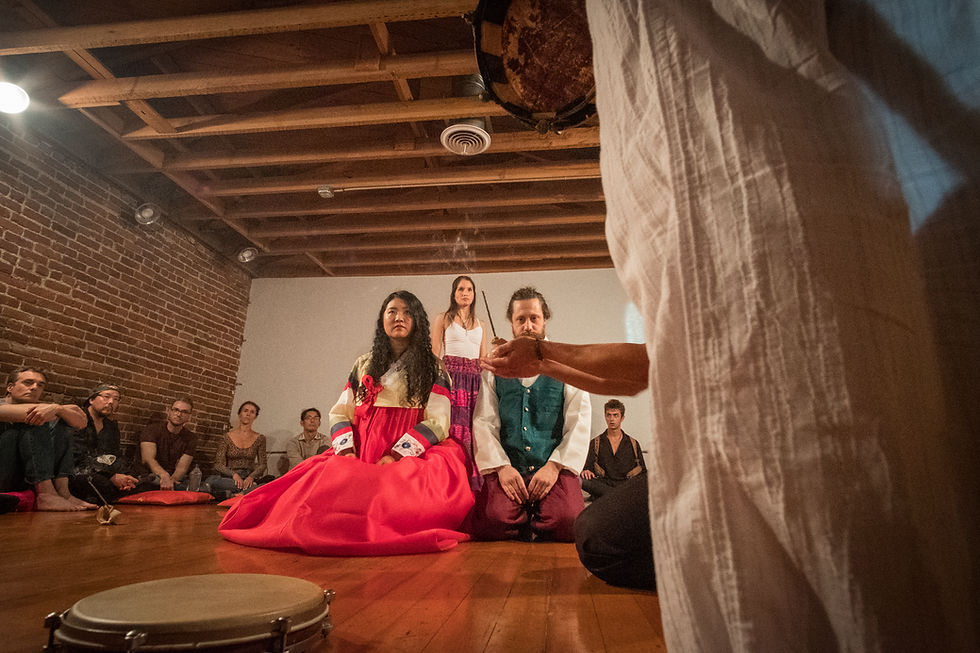
During one month’s little death, The Mortuary’s monthly salon for participatory performance, we got married for real. Our best friends and complete strangers thought they were just coming to a show. Together, we made a wedding happen. (Photo by Jonathan Potter)
We built The Mortuary because, as artists, we were hungry for a place to try things with other people. So much of the messy process of developing new work was expected to happen alone, in our heads, on our own dime. We wanted a room full of humans from the very beginning: a place to chance something, fail, follow a compulsion, and figure out what a work needed and is, by doing together.
We quickly realized we weren't the only ones hungry for this kind of place. On any given night, someone would be making spaghetti in the kitchen or throwing spaghetti at the wall in the studio.
Live action role playing became our favorite ritual: the spirit of the whole place in a pocket world. Playing together, being playful, and seriously playing allowed us to slip in and out of roles and try on different relationships. “The play is the thing” (Hamlet, Act 2, Scene 2)! Shakespeare may have been on to something.
This became my modus operandi. When the existing structure cannot hold the relationships I am looking for, I build a house that can. I live inside it with other people. We build and rebuild it together. What each house teaches me travels into the next. When another kind of house is needed, we build again. And again.
A few years later, Jake Pinholster and I co-founded Worlds in Play: a gathering of “play practitioners” at the intersection of theatre and games⁶. At our gatherings—first at the ASU MIX Center in Mesa, Arizona, and later at Allerton Retreat Center with the University of Illinois Urbana-Champaign—we might playtest eighty experiments in various states of becoming. Theatre, games, XR, and unclassifiable forms all belong, in our shared pursuit of “exploring new forms of agency in storytelling and experience”⁶. The only rule: no talking heads. Everyone has to test something.

Robert Farid Karimi playtesting The Mint Experience! at Worlds in Play (Photo by Emily Hanaoka)
Instead of curating projects, we ask artists “what do you need right now?” Then we build around the artists' needs. That became our producing methodology. Someone might need twenty warm bodies to test an interaction; someone else, a full mocap rig to work out impossible physics; and someone else, dental dams. Some artists arrive with major commissions nearing premiere; others, an inkling.
We take turns playing roles for one another. An artist joins an interspecies larp by Ash Eliza Smith and Robert Twomey to play with fellow sapiens and fish. A presenter crawls around testing a new immersive theatre project by Mister & Mischief alongside an eight-year-old. We stay up all night inventing an Alternate Reality Game set seven generations in the future.
In Alejandro Tey's Kaiju game-in-progress, we become ordinary people facing a giant monster none of us can understand—or survive—alone. Our only chance is to figure out what the monster means together. In a playtest of Ontroerend Goed’s SUMMIT, director Alexander Devriendt explored participation in theater as a way to examine how we participate in democracy, asking how having a voice or a role might translate into meaningful power.
Unresolved Rage Game, a theatrical Table Top Role Playing Game created by Risa Puno, has found home at Worlds in Play over multiple years. Imagine Dungeons and Dragons, but you combat racism and misogyny instead of monsters.
The game begins with the Game Moderator asking each player to weave our lived experience into a fictional character, each with a different relationship to rage—how much they recognize it internally and how much they express it outwardly. My own rage felt profoundly alien to me; I had become practiced at metabolizing it into anxiety, fear, humor, productivity. Each time I played, negotiating rage alongside fellow Asian women and femmes opened up my relationship to my own.
But my favorite mechanic in the game is collective rage: a shared stat that accumulates for the entire table, in response to how each player navigates their own rage. When it reaches a breaking point, players must work together to deal with the consequences. My rage does not compete with yours for recognition—your rage actually helps mine be recognized.
I still play Unresolved Rage Game when I'm not playing Unresolved Rage Game. I often roll a mental “rage dice”⁷. I catch myself wondering where my “acceptability dial” has landed, somewhere between “model minority” and “dangerous”⁷. I started passing its mechanics to friends. The game distributed itself into our lives.
The more I played, the less “agency” seemed adequate to describe what was happening. Agency—the word the immersive field often uses to describe the audience's power—sometimes resembled rugged individualism, casting the participant as an autonomous actor, measuring freedom by the choices available to them. What can I do? What choices can I make? How much control do I have?
That was the logic of the grid: power moving from one place to another. Give the audience more of it. Give me more of it. But more power did not necessarily mean more relationship. I could have all that agency and still be alone.
But in Unresolved Rage Game, my possibilities depend on yours. The experiences, in art and in life, that have transformed me the most weren't the ones in which I exercised the most individual control. They were the ones in which my possibilities became entangled with someone else's. It felt taboo to admit: sometimes, agency seemed to get in the way of relationships.
I started to feel queasy about another word we use constantly: impact. At this year's Worlds in Play, I joked to artist Janani Balasubramanian that “impact killed the dinosaurs” in the sense of a cosmic collision, one thing exerting force upon another. Whether we mean the impact of a work on an audience or its broader social impact, why does our field so often imagine impact as a single vector, a single moment?
Janani pointed out what “impact” evokes as a natural metaphor: “crater, force, blast radius, surface, one time event.” He wondered about other metaphors from nature: “still with immensity and power but with greater sense of time and expanded directionality, the way that mountains and rivers forever co-create each other.”
At Worlds in Play, I watch impact accumulate through relationships—and become distributed. Playtesting reveals not only what a work might become, but who might care about it, where it might live, and what relationships might carry it there. “Who is this work for?” stops being a line in a project deck and becomes something we find out with our bodies. (For a discussion of how grant proposals can corrupt this concept of “who is this work for?” see Matias Katajavaara Seidler’s article, “The User Who Exists on Paper.”) Works playtested at Worlds in Play have travelled into aquariums, voter education workshops, one-on-one clinical therapy sessions, and performing arts centers. The work finds its pathways into the world while it is still becoming.
4. A Brief Note on Emergence
And then, there are things no one could've possibly imagined.
On the rooftop of the Ace Hotel in Downtown Los Angeles, I pressed play on a tape recorder. I was there to experience Greg Wohead's Hurtling, an audio experience for one. His voice directed my gaze across the skyline as strange things unfolded on rooftops near and far. I couldn't tell what was staged and what was simply Los Angeles.

Hurtling (Image by Asher Thornton, courtesy of Greg Wohead)
Then, a stranger tapped my shoulder. A woman asked me, apologizing profusely for interrupting, to help translate a letter for her son. Obviously, I assumed she was part of the piece. By then, the work had trained me that anything entering my field of attention belongs there. So, we wrote the letter together. Afterward, I told the docent how moved I was by the encounter. He had no idea what I was talking about. The woman wasn't a performer. The letter wasn't part of the piece.
But it was. The artist had not authored the encounter, but he created the conditions—my heightened attention, my openness to a stranger, the porousness between fiction and city—in which it could emerge⁸.
At the time, I was wrestling with whether Los Angeles was home. A surprise encounter transformed my relationship to the city and it has been home ever since. How much of what becomes possible between us can we really know in advance? And what might we miss when we try to control every permutation?
5. Interdependence
This summer, when I was trying to put a finger on this more relational approach to agency and impact, Risa, the artist behind Unresolved Rage Game, suggested I try thinking in a different language. She offered bayanihan: the Filipino tradition of a village carrying a house together, and more broadly, an ethos of mutual responsibility.
I immediately thought of gye: a traditional Korean mutual-aid cooperative. My family, farmers and miners, had been a part of many gyes. Members pool resources to make possible what might be difficult for any one person to weather alone: weddings, funerals, emergencies. Gye depends on its members seeing their health as interwoven and assuming responsibility for one another.
No individual can carry the house alone. Bayanihan and gye embody what I had been circling all along: interdependence. The capacity to move the house emerges because the village gathers. A gye does not redistribute resources from one powerful member to less powerful ones; its members generate collective power⁹.
As I write, I am preparing for the premiere of BEASTS this fall at The Music Center in Los Angeles. Created by myself and Anthony Storniolo, BEASTS is a participatory installation where your physical body becomes a part of virtual worlds inhabited by gwoemul, shapeshifting beasts from Korean folklore. For centuries, gwoemul have given shape to the unknown. In BEASTS, they are reborn in the Korean diaspora: an ever-changing landscape of bodies, cultures and histories, where belonging happens in the act of shapeshifting.

Still from BEASTS: The Six-Part Woman at a karaoke room floating somewhere between Seoul and Los Angeles, built in Unreal Engine.
In the grid, the audience is the load—where the power finally stops. In BEASTS, interdependence is the dramaturgical logic. The beasts have stories to tell, but need your body to tell them. The Six-Part Woman lends you her arms, legs, torso, and head—a new way of experiencing your own body—and in return, you vow to avenge her. A horde of rat-men at the market invites you to dance, but they cannot dance until your body gives them choreography. A slug knows where the magic flowers grow but cannot reach them without you.
I wonder if Beasts could be a small rehearsal for interdependence. Not what can I do here, but what can we make possible for one another?
Access. Agency. Impact. Distribution. Sometimes, these are different buzzwords for the same underlying logic: someone has something, and someone else receives it. Power travels from here to there. But what if the relationship itself changes what is possible?
The Village: A visual interpretation by Samantha Bendix.
In the grid approach, distribution is an end problem: make the work, and then figure out how to get it out there. And also, a reach problem: find more people. In the grid, power is generated somewhere, routed, delivered. The roles hold still so the current can move. A system like that can send more power toward me without ever becoming capable of responding to me. Drive-thru dramaturgy, at the scale of the field.
So I kept hacking apart the grid. And when it couldn't hold the relationships I was after, I built a house that could. And another. And another. Perhaps, then, a new model for immersive—both the work and the field—could look less like a grid and more like a village: houses built and rebuilt in real time through our relationships. A quantum field of possibilities where futures take shape through reciprocal encounters. No fixed generator and no final recipient. Fleshy, glitching, always becoming¹⁰.
The village model, rooted in interdependence, offers a different framework altogether: some forms of power don't begin to exist until we come together. Our relationships themselves are generators. A splashy premiere can absolutely transform the life of a work. But I am way more interested in who needs to gather around a work for its full life.
Presenters, funders, community partners, researchers, advocates, audiences, might each bring different resources, relationships, knowledge, and reasons for caring about what the work might become. An institution may bring infrastructure and a platform; an artist may bring relationships, methodologies, field insights, and imagination. The village isn't assembled just to exhibit the work. It makes its life possible.
Care becomes infrastructure: the ongoing work of tending the relationships so that people can keep shaping the work, and the work can keep reshaping the people¹¹.
I used to think that the teenager who kept returning to Sleep No More wanted more agency. But I don't think that's what she actually wanted. She didn't want to control the world. She wanted to matter.
Belonging was never about gaining access to someone else's world. Not even about building a world of my own. Belonging, perhaps, begins when we build, rebuild, and carry the house together.
Endnotes
[1] Eng, D. L., & Han, S. (2019). Racial melancholia, racial dissociation: On the social and psychic lives of Asian Americans. Duke University Press.
[2] Mei Ann Teo, then Director of New Work at OSF and a colleague I worked closely with, would urge us to ask: "How do we move from consumption to communion?"—a question about our relationship with audiences, and the relationships among audience members.
[3] In Augusto Boal’s Theatre of the Oppressed (Urizen Books, 1974), audiences become "spect-actors," empowered to intervene in a theatrical situation and change how it unfolds, and, by extension, rehearse the capacity to do the same in civic life. For Boal, experimenting with form was experimenting with power.
[4] Ellis, S. (2021, September 30). Transmedia, technology, and the future of theatre [Talk]. Mahindra Humanities Center, Harvard University. https://mahindrahumanities.harvard.edu/event/transmedia-technology-and-future-theatre
[5] The Mortuary. (2018). The Mortuary. themortuaryla.com
[6] Worlds in Play. (2025). Worlds in Play. worldsinplay.com
[7] Puno, R. (2024–present). Unresolved Rage Game [Tabletop role-playing game]. https://www.risapuno.com/unresolved-rage-game
[8] My thinking about emergence is influenced by adrienne maree brown's Emergent Strategy: Shaping Change, Changing Worlds (AK Press, 2017).
[9] We may not need to invent novel models for interdependence. Live theatre, games, and ritual already offer ways to understand the encounter itself as the medium. What if we approached immersive media as an experiential, embodied medium, rather than primarily an optical one inherited from film? Could our definition of technology encompass ancestral technologies? Instead of chasing ever more convincing simulations and seamless transitions, what if this moment of technological upheaval became an opportunity to deepen our relational possibilities?
[10] My thinking about the glitch as a generative site of refusal and transformation is influenced by Legacy Russell’s Glitch Feminism: A Manifesto (Verso, 2020).
[11] Sometimes being a producer feels like a return to my very first job: translating. An act of care. When I co-founded the Independent XR Distribution Coalition with Julia Scott-Stevenson and Sarah Wolozin, I was deeply moved to find kinship with fellow independent producers among our advisors. Though we worked independently, we recognized one another in our shared role in the field. This relational stewardship gives life to an immersive field constantly reconfiguring itself across legacy and emergent terrains.
Scarlett Kim

Scarlett Kim is a director and producer innovating the intersection of live performance and immersive media, working across Los Angeles and Seoul. A polymath, Scarlett creates participatory experiences drawing from theatre, XR, games, and ritual. She is Executive Creative Producer of Center for Unclassifiable Technologies & Experiences (C.U.T.E.) and has co-founded Worlds in Play, Independent XR Distribution Coalition and The Mortuary. She serves on the board and interim leadership team of Los Angeles Performance Practice. She has developed and presented work with trailblazing artists and institutions such as Chloé Zhao, Royal Shakespeare Company, Stanford Arts, and The Music Center. Previously, she was Director of Innovation & Strategy of the Oregon Shakespeare Festival. Scarlett was honored on the XLIST 2025, a celebration of the 100 most creative visionaries in the experiential economy. MFA, CalArts. BA, University of Chicago.
Affiliation: Center for Unclassifiable Technologies & Experiences (C.U.T.E.)