
Updated: 4 days ago
issue 1
spring 2026
Between Worlds: Recognition Without Endurance in Cultural XR
A media scholar examines the value of “Cultural XR” as it struggles to be experienced by audiences beyond festivals.

"A Linha" (The Line), as presented at the 2019 Venice Film Festival. Photograph by Agnese Pietrobon (used with permission)
Editor's Introduction
It’s no secret that much of what is labeled as impact XR is primarily distributed at costly, short-term festivals. These are places where maybe a few hundred audience members can pass through an intricately designed space to experience socially-relevant XR projects. Writer Michael Golembewski knows this world well after working on several festival-lauded “Cultural XR” projects. He also knows the challenge of digital distribution for these projects on platforms like STEAM where “Cultural XR” goes virtually unnoticed, despite festival accolades. In “Between Worlds,” Mike details why festivals are such poor starting points for projects that try to reach the public on gaming platforms, and explains the nascent location-based distribution networks that may solve this. His article raises important ethical and impact questions around the social value of XR projects that are increasingly geared towards festivals that often cater to a privileged few.
I. Introduction
A work premieres at a major festival to critical acclaim. Audiences line up, headsets are donned, and for a brief window the project becomes the center of a specialized universe. By conventional cultural measures, it succeeds. Almost as soon as the awards are handed out, it disappears.
This is the immersive field’s recurring ghost story: a high-profile premiere that yields recognition, but not a durable afterlife. The sequence is familiar—premiere, review cycle, a short run of institutional attention—and then the trail goes cold. Recognition arrives in spikes. Access and legibility decay as exhibitions end and attention shifts. The default answer, for most practitioners, is to move the work onto commercial platforms (Steam and the Meta Quest Store chief among them) where it can remain available indefinitely as purchasable software.
In practice, that move is where the trouble begins. Festivals, exhibitions, and museums generate recognition through selection, facilitation, and shared discourse. What rarely survives the transition to a commercial storefront is the interpretive scaffolding that makes these works readable in the first place.
The works at the center of this are what this essay calls Cultural XR: authored, finite experiences spanning narrative XR, interactive documentary, virtual installation, and adjacent forms. Designed for situated encounters rather than replay or mechanical depth, they depend on framing—context, facilitation, and the social situation of viewing. That dependence is what makes the handoff to platforms so consequential.
The consequences are both cultural and financial. Cultural XR routinely justifies its existence through impact claims: that an encounter can shift understanding, deepen empathy, or reframe lived experience. But impact depends on circulation, not just premiere intensity. When access and interpretive support collapse after the festival window, that potential contracts into a single event. Without durable distribution, the financial case for making such work erodes alongside the cultural one.
And these are not marginal works. Cultural XR includes some of the field’s strongest, most affecting pieces: critically acclaimed, festival-selected, award-winning experiences whose quality is not in question. And yet, on commercial storefronts, they often wither—quiet in the signals platforms use to measure relevance, and frequently misread in the evaluative language those platforms reward.
Examining that withering clarifies the conditions that make Cultural XR legible, and demonstrates what happens when those conditions are removed. This essay traces the handoff from curated circuit to commercial storefront to show what changes when the encounter frame disappears, and how platforms reclassify finite, authored experiences as comparable entertainment products. Drawing on public storefront traces from Steam and the Meta Quest Store, it shows why critical recognition does not reliably convert into revenue-bearing visibility or stable legibility over time. Artworld theory provides the conceptual frame for that mismatch, and recent institutional responses—particularly the turn toward location-based entertainment—show how some practitioners are finding their way around it.
The broader argument is practical: for those who make Cultural XR, endurance cannot be left to chance. It has to be authored—designed, budgeted, and maintained as part of the work’s form, not deferred as a post-premiere afterthought.
II. One Project, Two Worlds
To understand the persistence gap, start with the work as it is meant to be encountered, and then watch what happens when the encounter frame falls away.
At the 2019 Venice Film Festival, a queue forms outside the exhibition space where A Linha: The Line will premiere [1]. Attendees skim the curator’s notes on the wall, trade comparisons with other titles in the program, and discuss what they have already seen. A facilitator offers a brief orientation—seated viewing, fifteen minutes, minimal interaction—and then the outside world drops away.
In virtual reality, viewers look down at a miniature diorama of 1940s São Paulo: a city rendered as a carefully handcrafted model, figurines moving through routines in a toy-train world. A dial turns; the scene shifts, and a poignant story of ordinary lives shaped and constrained by routine, class, and inherited rules unfolds Fifteen minutes later, headsets come off and people compare reactions—someone mentions the ending, another the characters, someone else the uncanny sense of scale, like watching over a small world.
Here, the work arrives not as a product to browse, but as an event to enter. Brevity reads as a formal decision. Framing is not external to the work; it is part of how the work becomes meaningful. Selection in the festival signals seriousness, facilitation sets expectations, and shared discourse carries the piece into interpretation—distributing the labor of reading across institutions, staff, and audiences.

Figure 1 : "A Linha" (The Line), as presented at the 2019 Venice Film Festival. Photograph by Agnese Pietrobon (used with permission)
Months later, the same title reappears as a thumbnail in a consumer storefront—tagged, priced, filed among other VR software [2, 4]. The facilitator is gone. Curator’s notes compress into store copy. The interface asks a different question: do you want to buy this?

Figure 2. The Line, as presented on the Steam Platform.
You purchase it and launch it from your library. Fifteen minutes later, it’s over. Nothing about the software has changed. What has changed is the context—and the evaluative norms that context supplies. A storefront must make thousands of titles comparable, so it leans on cues it can operationalize at scale: categories and tags, ratings, review volume, update signals. These establish credibility and visibility, but through a vocabulary optimized for comparison rather than guided encounter. What was once an event to enter now appears as a product filed alongside games.
The handoff matters because persistence is not only a question of availability. A work can remain accessible and still, in practice, disappear if the framing that once made it legible does not travel with it. This is the problem the essay calls interpretive persistence: whether a work’s intended reading—and therefore its claimed impact—can endure as it moves across contexts and over time. Storefronts are where Cultural XR is most often expected to persist by default, and they expose, with unusual clarity, exactly what is lost in translation.
III. Evidence
Platforms do not disclose sales, retention, or ranking logic in a form that can be independently audited. What they do disclose—prominently and durably—are public-facing cues such as aggregate ratings, written review counts, sentiment labels, and a ranked subset of review text. This section reads those cues as platform-legible traces: signals that shape purchase expectations and that platforms can display and recirculate at scale. Data were captured from Steam and the Meta Quest Store during a single observation window (between January 10 and January 15, 2026) using each storefront’s default presentation, including the “Most relevant” review filter, because that is the surface prospective users actually inherit as framing.
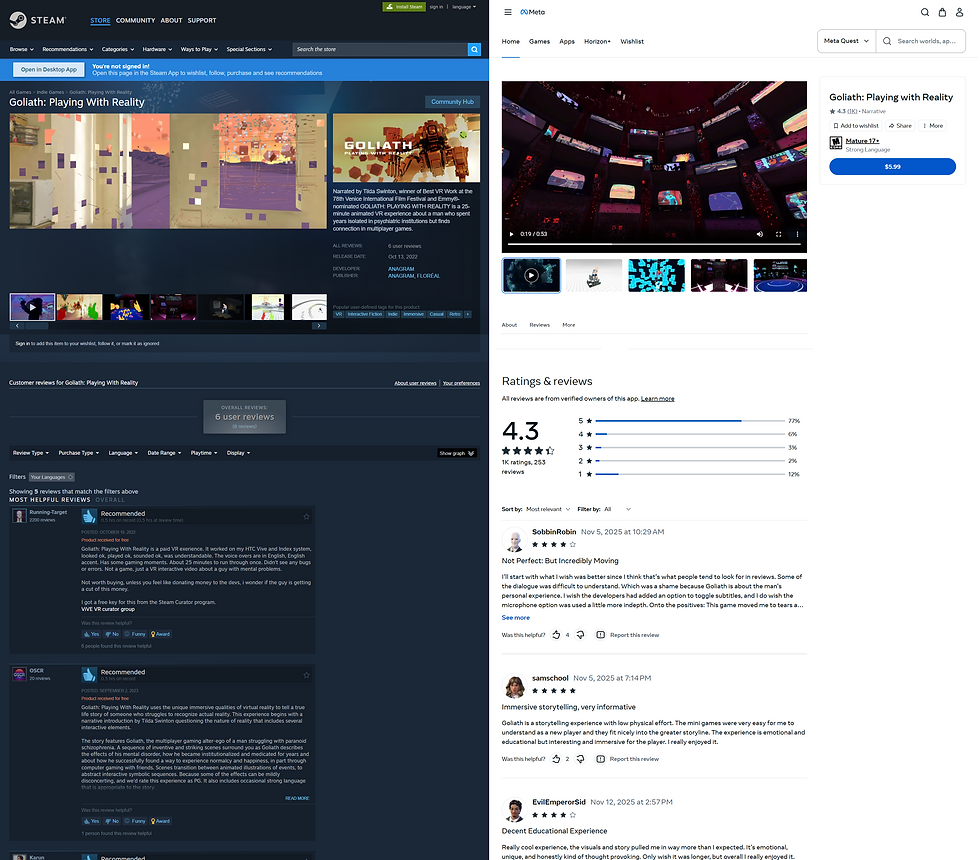
Figure 3. Goliath: Playing with Reality, as presented on the Steam Platform and the Meta Quest store.
Case selection
The analysis focuses on Steam and the Meta Quest Store because they are widely treated as the default afterlife for culturally recognized XR, and because they expose broadly comparable signals across different hardware and audience regimes. The Cultural XR sample is intentionally conservative. Inclusion criteria were: (1) finite, authored encounter-form design (not replay-oriented), (2) major curated-circuit recognition, and (3) availability on Steam and/or the Meta Quest Store during the capture window. These titles were selected precisely because their cultural credentials are beyond dispute, which makes any platform mismatch difficult to attribute to artistic quality. The selection rationale is summarized in Table 1.
Table 1: Cultural XR sample and recognition | ||
Year | Project and Studio | Major Awards & Nominations |
2016 | Notes on Blindness: Into Darkness [8] (Ex Nihilo / ARTE) | Tribeca Storyscapes Award; Sundance Official Selection; Peabody Award – Digital & Interactive Storytelling |
2019 | The Key [9] (Lucid Dreams) | Venice Grand Jury Prize (Best VR); Tribeca Storyscapes Award; Sundance New Frontier Official Selection |
2019 | The Line [10] (ARVORE) | Venice Best VR Interactive Experience; Cannes XR Official Selection; Primetime Emmy® – Outstanding Innovation |
2021 | Goliath: Playing with Reality [11] (Anagram) | Venice Grand Jury Prize (Best VR); Sundance Official Selection; News & Documentary Emmy® Nomination – Interactive Innovation |
Each project represents a high-performing Cultural XR work, widely recognized for its artistic craft, critical impact, and cultural relevance both within the curated XR circuit and through broader international cultural recognition | ||
For the qualitative layer, review excerpts are drawn from each platform’s “Most relevant” filter—the surface prospective users actually see, and therefore the one most likely to shape expectation and framing.
Quantitative signals: visibility and scale
Steam foregrounds written review volume alongside sentiment labels; Quest emphasizes rating totals and written reviews. These are not direct measures of quality or sales. They are durable public traces that act, in practice, as proxies for relevance in a crowded catalog. Written review volume is used as the shared proxy for cross-platform comparison, as it is one of the few signals that behaves similarly across both ecosystems.
Table 2: High-performing cultural XR public storefront signals | ||||
Title | Platform | Star Rating | Ratings | User Reviews |
The Line [2] | Steam | Very Positive | N/A | 40 |
Goliath: Playing with Reality [3] | Steam | Mostly Positive | N/A | 6 |
The Line [4] | Meta Quest | 4.5 | 309 | 137 |
Goliath: Playing with Reality [5] | Meta Quest | 4.3 | 1K | 253 |
Notes on Blindness: Into Darkness [6] | Meta Quest | 4.4 | 582 | 126 |
The Key [7] | Meta Quest | 4.8 | 958 | 236 |
The Steam platform does not provide distinct rating counts, only review counts. | ||||
Despite strong cultural recognition, these titles register as low-volume in the traces storefronts preserve. On Quest, they cluster in the hundreds to low thousands of ratings and the low hundreds of written reviews; on Steam, review counts often remain in the single or double digits. In platform terms, they arrive quiet: well-liked by those who find them, but lightly signaled in the visibility economy storefronts are built around.
Table 3 shows what the storefront system is calibrated to detect and amplify. The point is not that Cultural XR should match these numbers, but that storefront evaluation operates at this scale—and visibility systems are tuned accordingly.
Table 3: High-performing platform-native public storefront signals | ||||
|---|---|---|---|---|
Title | Platform | Star Rating | Ratings | User Reviews |
Counter-Strike 2 [12] | Steam | Very Positive | N/A | 9.4M |
Baldur’s Gate 3 [13] | Steam | Overwhelmingly Positive | N/A | 723K |
Beat Saber [14] | Steam | Overwhelmingly Positive | N/A | 52K |
Gorilla Tag [15] | Steam | Very Positive | N/A | 41K |
Beat Saber [16] | Meta Quest | 4.5 | 54K | 9K |
Gorilla Tag [17] | Meta Quest | 4.3 | 168K | 9.3K |
The Steam platform does not provide distinct rating counts, only review counts. | ||||
These comparison titles are not direct aesthetic peers. They represent replay-oriented, mechanics-driven experiences that storefront systems are optimized to detect and recirculate. The contrast is therefore not only quantitative but ontological: storefront visibility systems are calibrated for repeatable engagement, while Cultural XR titles are authored as finite encounters. Table 4 makes the scale of that mismatch concrete.
Table 4: Public storefront signal comparisons. | |||||
Platform | Cultural XR | Reviews | Compared To | Reviews | Visibility Ratio |
Steam | Goliath | 6 | Counter-Strike 2 | 9,355,333 | 1 : 1,559,222 |
Steam | The Line | 40 | Baldurs Gate 3 | 723,446 | 1 : 18,086 |
Steam | Goliath | 6 | Gorilla Tag | 41,000 | 1 : 6,833 |
Steam | The Line | 40 | Beat Saber | 52,000 | 1 : 1,300 |
Meta Quest | Notes on Blindness | 126 | Beat Saber | 9,000 | 1 : 71 |
Meta Quest | Goliath | 253 | Gorilla Tag | 9,300 | 1 : 37 |
Meta Quest | The Key | 236 | Beat Saber | 9,000 | 1 : 38 |
Meta Quest | The Line | 137 | Gorilla Tag | 9,300 | 1 : 68 |
Even when the benchmark stays close to XR-native hits, the gap remains large—often tens to thousands of times more visible in the traces storefronts treat as signs of ongoing relevance. The tables point to a visibility mismatch, not an artistic one: culturally recognized, finite works enter storefront ecosystems under-signaled in the cues those systems most reliably detect and recirculate.
Quantitative signals: how works get read
The quantitative layer shows a scale problem. The qualitative layer shows how that problem appears in language—how works are read once the storefront’s default frame becomes the interpretive frame. The reviews gathered capture audiences moving between two modes: the culturally framed encounter and the software entertainment product evaluated inside a commercial interface. What looks like confusion is often translation—people trying to read encounter-form work using storefront-native categories.
Appreciation without the right frame. Even within the storefront context, the overall tone is often positive, with comments foregrounding affect, craft, and intention.
Comment Excerpt | Project | Platform |
“This game moved me to tears…” | Goliath | Meta Quest |
“Absolutely loved this story & experience…” | The Line | Meta Quest |
“It is beautifully made and very poignant.” | Notes on Blindness | Meta Quest |
Reclassification. A recurring move is to suspend the default category and tell the next reader how to approach the work—micro-curatorial notes that supply, informally, the scaffolding festivals and exhibitions typically provide.
Comment Excerpt | Project | Platform |
“If you're searching for a traditional game, this is not the right choice.” | The Line | Meta Quest |
“Not interesting from a ‘game’ perspective…” | The Line | Steam |
“It’s not a game! Just sit back and enjoy a wonderfully told story.”” | The Line | Meta Quest |
Duration as value. Even sympathetic reviews slip into transactional accounting. Runtime becomes a proxy for worth, and brevity becomes a metric that must be justified or forgiven, even when it is a deliberate formal choice.
Comment Excerpt | Project | Platform |
“Nice little story. takes about 15-20 minutes.” | The Line | Steam |
“Great experience, just very brief.” | Notes on Blindness | Meta Quest |
“Only wish it was longer…” | Goliath | Meta Quest |
Interaction as feature depth. Minimal agency is read as deficit rather than dramaturgy—a missing mechanic rather than a deliberate focusing of attention.
Comment Excerpt | Project | Platform |
“While there is some interaction, it's minimal…” | The Key | Meta Quest |
“Nice short story with very basic interactions.” | The Line | Steam |
Frame collapse. Where encounter framing has fully dissolved, purchase regret and technical failure are all that remain. The experience is then evaluated purely as a faulty product.
Comment Excerpt | Project | Platform |
“It's charming… It's not worth the full price to me.” | The Line | Steam |
“Broken — Doesn't go past the title screen” | Notes on Blindness | Meta Quest |
Taken together, the traces point to an interpretive persistence problem that is simultaneously quantitative and qualitative. Quantitatively, these works remain low-volume in the public cues storefronts treat as credibility and relevance, limiting their chances of being surfaced through ordinary browsing and social proof. Qualitatively, the most visible language around them repeatedly performs compensatory framing—reclassifying them away from “game,” justifying brevity as value, and interpreting minimal interaction as missing feature depth. Because ratings and review excerpts become part of the inherited frame for the next purchaser, thin signal densities combined with these reclassifications increase the likelihood that encounter-form work is evaluated as an under-delivering product rather than achieving its formal intention.
IV. Context
The storefront evidence shows the persistence problem in its most legible form: quiet signals, unstable readings, and the collapse of encounter framing into product logic. But the platform is not the cause of the mismatch. It is where the mismatch becomes visible. The deeper issue is that Cultural XR moves between contexts whose evaluative norms are genuinely different, and recognition earned in one does not automatically convert into legibility in another. To understand why, it helps to look at what framing actually does—and what is lost when it disappears.
Meaning in cultural work depends not only on the object itself, but on the conditions that frame how it should be read. As philosopher Arthur Danto argued, meaning does not reside in perceptual properties alone, but in the conditions that signal what something is and how it should be approached [18]. Warhol’s Brillo Boxes make this visible: in a gallery, they are art; in a supermarket, they are packaging. The difference is not the object. It is the surrounding conditions that tell us what kind of thing this is.
Cultural XR offers a clear contemporary case. An authored headset work encountered inside a curated program is approached as a culturally serious encounter—finite, interpreted, shaped by exhibition expectations. The same software encountered as a storefront thumbnail is approached as an entertainment product: priced, categorized, compared, and evaluated against a different canon. The artifact may not change, but the standards by which it is judged do.
This shift reveals two distinct currencies that do not automatically convert. Curated contexts generate interpretive currency: selection, facilitation, discourse, and shared practices that help audiences read a work. Storefront contexts reward engagement currency: comparability, visible activity, and the accumulation of public traces—ratings, review volume, update cadence, repeat interaction—that scale for strangers making quick decisions. Platforms do not operationalize awards or institutional discourse as visibility inputs. They operationalize activity and standardized cues.
George Dickie’s concept of the artworld helps specify why. An artworld is a system of roles and conventions—artists, curators, institutions, critics, audiences—through which something becomes legible as art rather than mere artifact [19]. Festivals do more than host immersive work: they enact an artworld that confers cultural legibility through selection, facilitation, and discourse. But as Howard Becker’s account of art worlds (plural) makes clear, no single artworld governs how all work is valued [20]. Cooperative networks produce and evaluate work according to shared but not universal criteria. When Cultural XR leaves the festival circuit and enters a platform ecosystem organized around game culture, storefront comparison, and ranking, it moves between art worlds, and what counts as meaningful in one (the art world of the festivals) does not reliably register as relevant in another (the art world of the platforms).
The storefront evidence shows what this looks like on the ground. Users repeatedly supply missing context—reclassifications, duration-as-value accounting, explanations of minimal interaction—doing interpretive work that, in premiere settings, is distributed across curators, facilitators, and peers. On platforms, that burden shifts onto audiences and metadata. Legibility after premiere becomes a contingent outcome of dispersed audience labor rather than a stable condition carried by institutions—and works that fail to accumulate platform-legible traces gradually recede from view.
V. Institutional Responses
This mismatch is not only theoretical; it shapes whether immersive work survives. Projects can be financed, premiered, and culturally validated, yet still fail to secure a durable, income- and impact- bearing afterlife. The 2024 Venice Immersive Think Tank is blunt: festivals function as a powerful launchpad, but for non-gaming immersive work the most reliable revenue pathway remains Location-Based Entertainment (LBE), while broader online distribution is still frictional and under-optimized [21].
LBE—ticketed, scheduled immersive experiences presented in physical locations where staff, space, and programming shape the encounter—is often framed as a business-model pivot within XR. It is more revealing as a movement between art worlds that happen to share fundamental premises.
Festival and LBE contexts both treat immersive work as an event rather than a product: meaning is time-bounded, interpretation is scaffolded, and value is demonstrated through successful presentation rather than accumulated activity traces. Both use selection and programming to signal seriousness. Both rely on facilitation—staff, orientation, physical context—to set audience expectations before the experience begins. Both measure success through attendance, institutional discourse, and repeat presentation rather than review velocity or engagement metrics.
When storefront afterlives stall, LBE does not require Cultural XR to translate itself into a foreign evaluative language. It restages the work inside a system that already knows how to read it. The Think Tank’s figures make that alignment concrete: for large-scale installations, endurance appears as throughput and repeat attendance—over 100 people per hour and totals exceeding 170,000 tickets across seven-month runs [21]. These are the variables the LBE artworld recognizes as persistence—capacity, scheduling, staffing, venue partnerships, repeat presentation—even though they do not drive storefront resurfacing.
The logic holds across scale. In Pursuit of Repetitive Beats, a guided roomscale VR installation about early UK rave culture, sustains its life through scheduled re-presentation, drawing meaning from the rituals of ticketed attendance as a part of the work itself [22]. Space Explorers: THE INFINITE scales the same premise through long venue runs and institutional partnerships, reaching over 500,000 viewers [23]. In both cases, the encounter frame travels with the work because the exhibition model is built to carry it.
In Pursuit of Repetitive Beats makes this “festival → LBE” handoff visible. In a festival context (e.g., GIFF), it is encountered as a programmed installation—time-slotted, introduced, and socially discussed—so brevity and minimal interaction read as formal decisions within an authored event.
In venue runs (e.g., the Barbican), the piece is not reimagined so much as re-mounted: ticketing becomes the interface, front-of-house becomes part of the scaffold, and endurance is measured in repeat presentation and throughput rather than platform-legible traces. The infrastructure changes, but the evaluative language stays aligned—the work remains an encounter that can be staged again.
Studios are increasingly formalizing this as a strategy. Atlas V, a Paris-based studio known for immersive narrative and interactive documentary, announced in early 2026 a deliberate shift toward casual VR gaming and LBE [24]. The framing is operational: online narrative VR “doesn't have the audience we hoped for,” budgets have “almost halved, or even reduced by two-thirds,” and distribution can yield “zero income” even after pre-financing [25].
What these moves suggest is not that platforms are useless, but that afterlife is a misleading default metaphor. Survival is not only about keeping a file downloadable; it is about carrying forward the conditions that make the work readable and part of a sustainable practice. Cultural XR translates more cleanly into art worlds that share its encounter premises—and the question that practitioners in the field should ask is how those conditions can be designed into new works from the start, rather than how to recover them through distribution pivots after the premiere is over.
VI. Conclusion: Designing for a Full Life
Creators of Cultural XR already design in active dialogue with the worlds a work will inhabit. Festival work duration is tuned to throughput and audience attention. Roomscale boundaries are shaped by booth dimensions and safety constraints. Interaction density is calibrated to facilitation realities and program tempo. This happens constantly, and rarely feels like compromise. It is part of how immersive form stabilizes within a given context, and part of the design language of festival work.

Figure 4. Festival-Specific Design Considerations for Cultural XR. (Michael Golembewski, 2026)
What the pivot towards LBE clarifies—and what the storefront evidence makes hard to ignore—is that this fluency has a gap. The encounter conditions of persistence rarely receive the same attention at the design stage that the conditions of premiere do. That is a problem, and it is a design process problem before it is a distribution one.
These issues can be considered at the start of a project, shaping the work before it is formed. If orientation is currently carried by a human facilitator, what version of it can travel inside the work itself—as an opening sequence, a tonal register, a contextual frame that tells an audience how to approach what follows? If brevity is a formal choice, how is it made legible to someone arriving without a curator? If shared discourse is generated by the festival context, what materials—production notes, creative statements, educator guides—can be authored alongside the work to seed that discourse elsewhere? The earlier in the lifecycle of the project that they are engaged with, the more effective design solutions will be. These are not afterthoughts. They are design decisions with direct consequences for whether (and how) the work remains readable after its initial showings.
The same logic applies to distribution. If a work's encounter conditions are structurally incompatible with platform storefronts—and the evidence suggests they often are—then storefronts should not be the default afterlife. Distribution pathways should be chosen at the financing stage, chosen to reflect where interpretive currency will actually be recognized. For some projects that means LBE from the outset, with venue relationships and touring logistics built into the production model. For others it means treating platforms as discovery surfaces rather than primary distribution, supported by institutional re-presentation that periodically restages the encounter frame. The distinction between interpretive currency and engagement currency is what makes these choices legible: it reframes afterlife not as keeping a file available, but as an authorship problem—carrying forward the conditions that let the work be read as intended.
We see evidence of this shift in newer XR distribution initiatives: the Montreal-based cultural institution and immersive production studio PHI is building an LBE pathway for post-festival circulation that treats distribution of Cultural XR as infrastructure—venue partnerships, remountable exhibition packages, and the touring logistics that keep work runnable across sites [26]. In such models, circulation is not assumed; it is constructed, and the interpretive/engagement split becomes an operational choice—preserving encounter conditions rather than defaulting to storefront engagement.
PHI’s initiative points to something larger than a single pathway: institutions are beginning to build the mechanisms that make encounter-form work repeatable—portable standards, operational knowledge, and the contextual apparatus that keeps a piece legible when it moves. More than just helping to solve distribution issues; it changes what gets designed. Once persistence has mechanisms, it becomes a formal constraint the work can answer.
There is reason for optimism in how the field has always responded to exactly this kind of pressure. Early VR required facilitation so intensive it was inseparable from the work itself, shaping a generation of formal decisions. Mobile and web formats demanded self-sufficiency, and new narrative structures emerged to meet that constraint. LBE has reintroduced the event frame as deliberate strategy rather than technical necessity, and work made for that context is already developing its own formal logic. The pattern is consistent: each time Cultural XR has been forced to negotiate a new interpretive frame or distribution model, it has not simply adapted its delivery—it has discovered new things it can be. The encounter conditions that feel like constraints at the financing stage have a way of becoming, in the hands of practitioners who take them seriously, the generative pressure from which new forms emerge. The persistence problem is real, but so is the history of a practice that has never stopped finding its shape.
End Notes
La Biennale di Venezia. (2019). The Line (A Linha) — Venice VR Expanded programme. https://www.labiennale.org/en/cinema/2019/venice-virtual-reality/linha
Valve Corporation. (2020). The Line [Store page on Steam]. https://store.steampowered.com/app/1214980/The_Line/
Valve Corporation. (2022). Goliath: Playing with Reality [Store page on Steam]. https://store.steampowered.com/app/2138380/Goliath_Playing_With_Reality/
Meta Platforms. (2020). The Line [Meta Quest Store page]. https://www.meta.com/experiences/the-line/2685959161497510/
Meta Platforms. (2021). Goliath: Playing with Reality [Meta Quest Store page]. https://www.meta.com/experiences/goliath-playing-with-reality/3432432656819712/
Meta Platforms. (2019). Notes on Blindness [Meta Quest Store page]. https://www.meta.com/experiences/notes-on-blindness/1946326588770583/
Meta Platforms. (2019). The Key [Meta Quest Store page]. https://www.meta.com/experiences/the-key/3457685900909916/
Novelab & Atlas V. (2019). Notes on Blindness [Project page]. https://www.notesonblindness.co.uk/vr
Lucid Dreams Productions. (2019). The Key [Project page]. https://www.luciddreamsprod.com/
ARVORE Immersive Experiences. (2019). The Line [Project page]. https://arvore.io/games/the-line
Anagram. (2022). Goliath: Playing with Reality [Project page]. https://www.goliathvr.io
Valve Corporation. (2026). Counter-Strike 2 [Store page on Steam]. https://store.steampowered.com/app/730/CounterStrike_2/
Larian Studios. (2023). Baldur’s Gate 3 [Store page on Steam]. Valve Corporation. https://store.steampowered.com/app/1086940/Baldurs_Gate_3/
Beat Games. (2019). Beat Saber [Store page on Steam]. Valve Corporation. https://store.steampowered.com/app/620980/Beat_Saber/
Another Axiom. (2022). Gorilla Tag [Store page on Steam]. Valve Corporation. https://store.steampowered.com/app/1533390/Gorilla_Tag/
Meta Platforms. (2019). Beat Saber [Meta Quest Store page]. https://www.meta.com/experiences/quest/2448060205267927/
Another Axiom. (2022). Gorilla Tag [Meta Quest Store page]. Meta Platforms. https://www.meta.com/experiences/quest/4979055762136823/
Danto, A. C. (1964). The artworld. The Journal of Philosophy, 61(19), 571–584. https://doi.org/10.2307/2022937
Dickie, G. (1974). Art and the aesthetic: An institutional analysis. Cornell University Press.
Becker, H. S. (1982). Art worlds. University of California Press.
Venice Immersive Think Tank. (2024). The LBE market: Immediate options to address the pressing needs of immersive distribution and exhibition in venues. La Biennale di Venezia. https://veniceproductionbridge.org/sites/default/files/documenti/file/venice-immersive-think-tank-2024-report.pdf
East City Films. (n.d.). In Pursuit of Repetitive Beats [Project page]. https://eastcityfilms.com/inpursuitofrepetitivebeats/
PHI Studio. (n.d.). Space Explorers: THE INFINITE [Project page]. https://phi.ca/en/studio/works/space-explorers-the-infinite/
Keslassy, E. (2026, January 28). Atlas V group raises $6 million to diversify into gaming and location-based VR. Variety. https://variety.com/2026/digital/global/atlas-v-raise-6-million-diversify-gaming-location-based-vr-1236642469/
Gayet, M. (2026, January 28). A pioneering studio in original immersive creation, Atlas V is accelerating its shift toward entertainment and location-based experiences. XRMust / XR Magazine. https://xrmust.com/xrmagazine/location-based-experiences-atlas-v/
Bye, K. (2024, December 23). #1516: Myriam Achard on Phi Studio’s Expansion into LBE Distribution & the Fusion of Immersive Art at Phi Contemporary. Voices of VR Podcast. https://voicesofvr.com/1516-myriam-achard-on-phi-studios-expansion-into-lbe-distribution-the-fusion-of-immersive-art-at-phi-contemporary/
Author disclosure: The author contributed to Goliath: Playing with Reality, one of the works discussed.
Michael Golembewski, PhD

Dr. Michael Golembewski is a designer-researcher working at the intersection of immersive media, cultural production, and human–computer interaction. His work examines how immersive experiences are authored, evaluated, and sustained across institutional contexts, with particular attention to process, interpretation, and craft. He directs MWG Design & Research, a consultancy focused on interactive design in cultural and public settings, and has contributed to a range of exhibition-based and location-based immersive projects.
Affiliation: MWG Design & Research